all Children are Artist’s
Picasso
Mallaguzi put’s it best saying that “Children need the freedom to appreciate the infinite resources of their hands, their eyes and their ears, the resources of forms, materials, sounds and colors.”
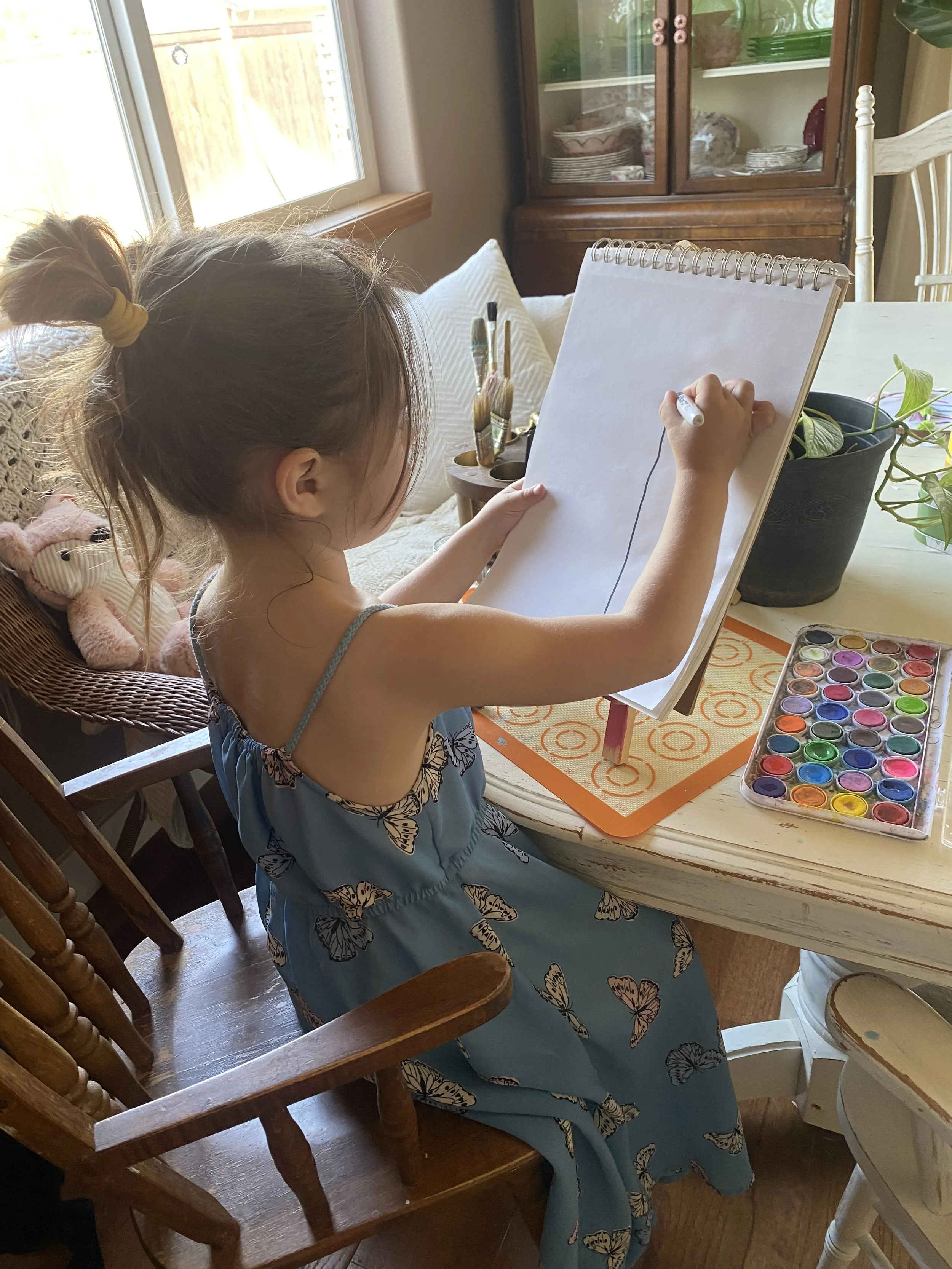
The "100 Languages of Children" are foundational for children’s exploration, agency, and meaning-making over predetermined products or adult-directed outcomes. Together they create a learning environment where curiosity, creativity, and emotional expression are valued as essential to development.
What process art is
Process art emphasizes the act of creating rather than the final artifact. Materials, movement, experimentation, and play are central.
The teacher’s role is to set up rich, open-ended invitations with accessible materials, observe, document, and support rather than direct.
Typical process art activities include loose parts play, painting with different tools and surfaces, clay exploration, sensory mark-making, and collaborative large-scale works.
Key benefits of process art
Cognitive development: Open-ended exploration supports problem-solving, hypothesis testing, cause-and-effect reasoning, and flexible thinking.
Fine and gross motor skills: Manipulating tools, materials, and large-format work builds coordination and control.
Creative risk-taking: Without a fixed “right” outcome, children experiment, iterate, and learn from failure.
Focus and persistence: Extended, uninterrupted time to explore deepens concentration and self-regulation.
Language and symbolic thinking: Describing processes, negotiating roles in group work, and creating symbolic representations foster communication and abstract thought.
Emotional expression and regulation: Materials offer a safe way to express feelings, process experiences, and build resilience.
What the "100 Languages of Children" means
Originating from the Reggio Emilia approach, the phrase refers to the many ways children express ideas and understand the world: drawing, movement, drama, construction, music, gesture, play, and more.
It reframes intelligence and learning as multimodal and culturally situated rather than solely verbal or testable.
The “languages” are not only expressive modes but means of thinking; each offers unique affordances for problem-solving and meaning-making.
How process art and the 100 Languages connect
Process art provides rich contexts where multiple languages can be practiced and combined. A child painting with sticks may be simultaneously using visual, bodily, and material languages.
Teachers document and interpret children's multiple languages to understand thinking, build on ideas, and co-construct longer-term projects.
Emphasizing process and multiple languages counters the narrow, outcome-driven messaging that creativity matters only if it produces a neat final product.