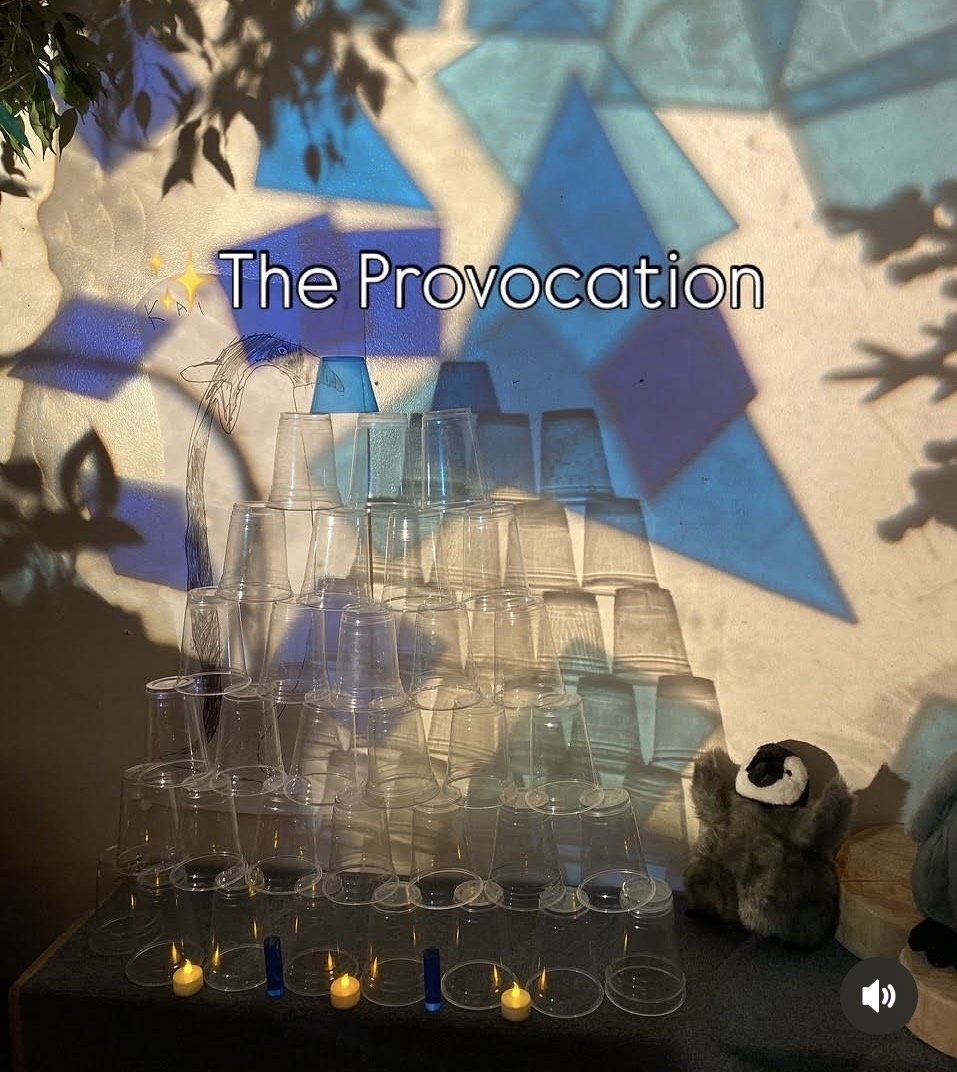
My work is highly inspired by the Reggio Emilia approach . This approach embodies children as competent, curious, and capable protagonists in their own learning. From birth they are full of a hundred languages—many ways of thinking, exploring, expressing, and knowing. Our role as educators, parents, and community members is to listen carefully to these languages and to create environments and experiences that make those languages visible, nurtured, and respected.
The image of the child shapes everything: the child is strong, rich in potential, possessing curiosity and interest in relationships with people and things. Knowledge is a process—an ongoing construction shaped by interactions with peers, teachers, materials, and the wider world. Learning is not the passive receipt of facts but an active, collaborative journey.
The environment is a teacher. Inviting children to wonder explore and create. Documentation is central. Teachers observe, listen, record, photograph, and display children’s ideas and process. Documentation makes thinking visible to children, families, and the community; it supports reflection, guides the curriculum, and honors children’s work as meaningful. Through documentation a public narrative of learning unfolds that can be revisited and extended.
Projects emerge from children’s interests, often growing into long-term investigations. These investigations are interdisciplinary, driven by questions and hypotheses, and use a wide range of expressive media—the “hundred languages” such as painting, sculpting, dramatic play, construction, movement, symbolic languages, and more.
Relationships are fundamental. Learning is social and dialogic. Teachers build strong, respectful relationships with each Child. Families are partners in the educational process.